
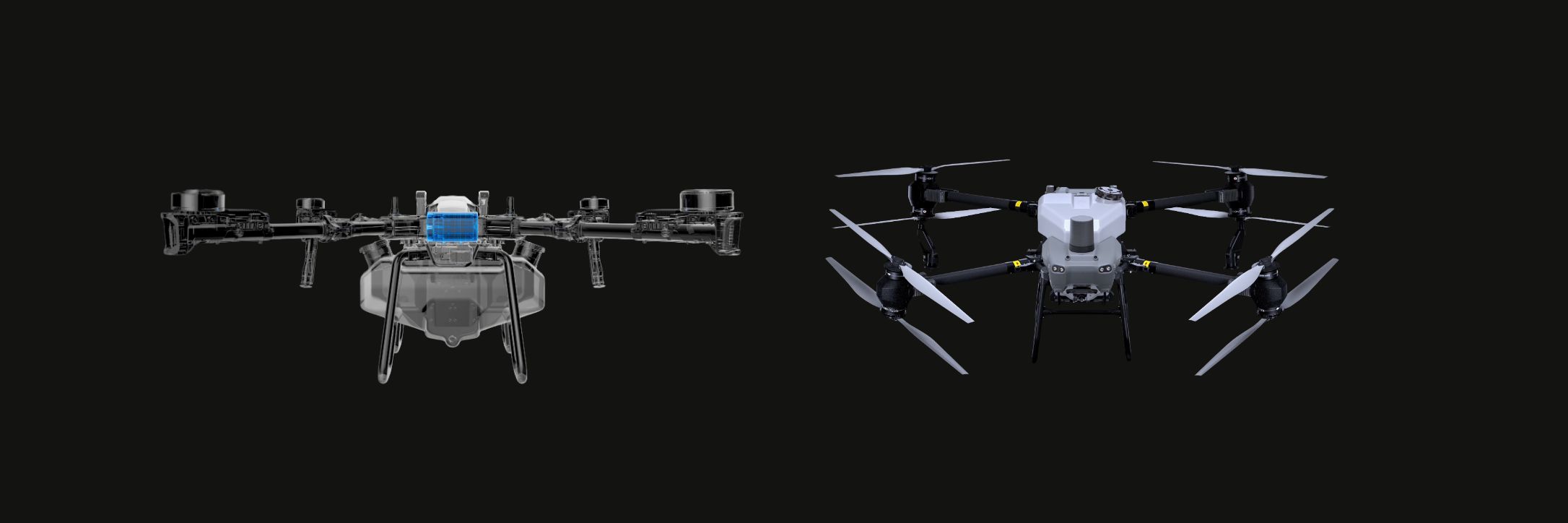
The short version
The DJI Agras T50 and the XAG P100 Pro are the two heavy-lift agricultural drones you will see most often in the UK. On paper they are closer than the marketing suggests: both are roughly 50 kg-class machines that spray and spread, both use RTK positioning, and both need exactly the same UK permissions. The meaningful differences are in the spray technology, the sensing, and above all how you buy and operate each one in the UK.
There is no outright winner. The better question is which fits the work you want to do and the way you want to run your business.
Specifications side by side
The figures below are manufacturer specifications and should be confirmed with a UK dealer, as kits and configurations change.
| Feature | DJI Agras T50 | XAG P100 Pro |
|---|---|---|
| Spray tank | 40 litres | Around 50 litres (RevoSpray) |
| Spread hopper | 75 litres, up to 50 kg | RevoCast granular system |
| Payload class | About 40 kg spray, 50 kg spread | Around 50 kg |
| Spray method | Dual atomising pressure nozzles | Centrifugal rotary atomisers, 60 to 400 micron |
| Weight in use | Around 92 kg loaded when spraying | Heavy-lift, well over 25 kg |
| Sensing | Phased-array radar and binocular vision | Radar and obstacle sensing |
| Positioning | RTK ready | RTK ready |
| Modularity | Separate spray and spread kits | Tool-free quick-swap spray and spread payloads |
| Build | Weather resistant | IPX7 water resistance |
| Manufacturer throughput | Up to about 21 ha per hour spraying in ideal conditions | Manufacturer figures vary; treat as best case |
| UK support route | Several independent DJI agriculture dealers | Largely via AutoSpray Systems and the ASPN network |
| Software | DJI Agras app and DJI Ag platform | XAG One app and XAG platform |
Spray and spread systems
The biggest technical difference is how each drone produces droplets. The DJI Agras T50 uses pressure nozzles with dual atomising sprinklers, while the XAG P100 Pro uses centrifugal rotary atomisers that spin the liquid into droplets.
In practice, rotary atomisers give fine, consistent control of droplet size, which matters for drift management and even coverage. Pressure nozzles are simple, well understood and tuned for high output. Neither is universally better: the right choice depends on the products and rates you apply and how you manage drift.
For spreading, both carry a granular unit, DJI's hopper and XAG's RevoCast, for seed, fertiliser and similar products. As with any drone, suitability comes down to granule size, flow and calibration rather than the airframe.
Sensing, safety and ease of use
DJI has built a strong reputation for sensing. The Agras T50's phased-array radar and binocular vision give it confident terrain following and obstacle awareness, which can make it forgiving on undulating or cluttered ground.
XAG aircraft also use radar and obstacle sensing and are known for a clean, app-led workflow and quick-swap payloads that move between spraying and spreading without tools. If you expect to switch between liquid and granular work often, that modularity is a genuine time-saver.
UK support and how you will operate
This is the difference that often decides it, and it is easy to miss if you only compare specifications.
DJI Agras machines are sold through several independent UK agriculture dealers, so you can buy the aircraft, arrange training and servicing, and operate as your own business under your own CAA authorisation.
XAG in the UK is channelled largely through AutoSpray Systems, the XAG distributor, and its AutoSpray Pilot Network (ASPN). Many XAG operators fly under AutoSpray's operational authorisation as the operator of record rather than holding their own. That can lower the barrier to getting started and provides a support structure, but it also means operating within a network rather than fully independently.
So the real question is not only which aircraft, but which way of operating suits you: independent ownership and authorisation, or joining a supported network.
Permissions and running costs
On permissions the two are identical. Both weigh well over 25 kg in use, so either way you need a bespoke CAA Operational Authorisation built on a Specific Operations Risk Assessment, with a General VLOS Certificate as the baseline qualification. Spraying licensed pesticides with either aircraft needs a Health and Safety Executive permit, because it counts as aerial spraying.
Running costs are broadly comparable and easy to underestimate. Budget beyond the aircraft for batteries, fast charging and a generator, training, insurance, servicing and spares. The cheapest machine to buy is not always the cheapest to run, so ask each dealer about battery life, replacement costs and service turnaround in season.
Which one suits you
Choose on the work and the support route, not the headline numbers:
- If you want to run fully independently and value a wide UK dealer and servicing network, the DJI Agras T50 is a natural choice.
- If you want fine droplet control, quick switching between liquid and granular work, or a supported route into operating, the XAG P100 Pro and the AutoSpray network are worth a close look.
- For most buyers the deciding factors are local support, training, servicing turnaround and how you want to be authorised, rather than a few litres of tank capacity.
Before committing, speak to a dealer and at least one working operator of each aircraft, and be clear about the services you can legally and profitably deliver in your area.
Related guides
- How to become an agricultural drone operator
- Agricultural drone training in the UK
- What to ask before hiring a drone operator
Useful links
Start with the operator directory, training providers, equipment page and quote request form.
FAQs
Is the DJI Agras T50 or XAG P100 Pro better for UK farming?
Neither is universally better. They are a similar heavy-lift class with the same permissions. The DJI Agras T50 suits operators who want to run independently with a wide dealer network, while the XAG P100 Pro and the AutoSpray network suit those who want fine droplet control, quick payload swaps or a supported route into operating.
Do the DJI Agras T50 and XAG P100 Pro need the same licences?
Yes. Both weigh well over 25 kg in use, so each needs a bespoke CAA Operational Authorisation and a General VLOS Certificate, and pesticide spraying with either needs a Health and Safety Executive permit.
What is the main difference between them?
The spray technology, DJI uses pressure nozzles and XAG uses centrifugal rotary atomisers, and more importantly in the UK the support route: DJI is sold through independent dealers for independent operation, while XAG is largely accessed through AutoSpray Systems and its pilot network.
How much do they cost?
Both are a significant investment and pricing changes, so confirm with a UK dealer. Budget for batteries, charging, training, insurance, servicing and spares on top of the aircraft.