
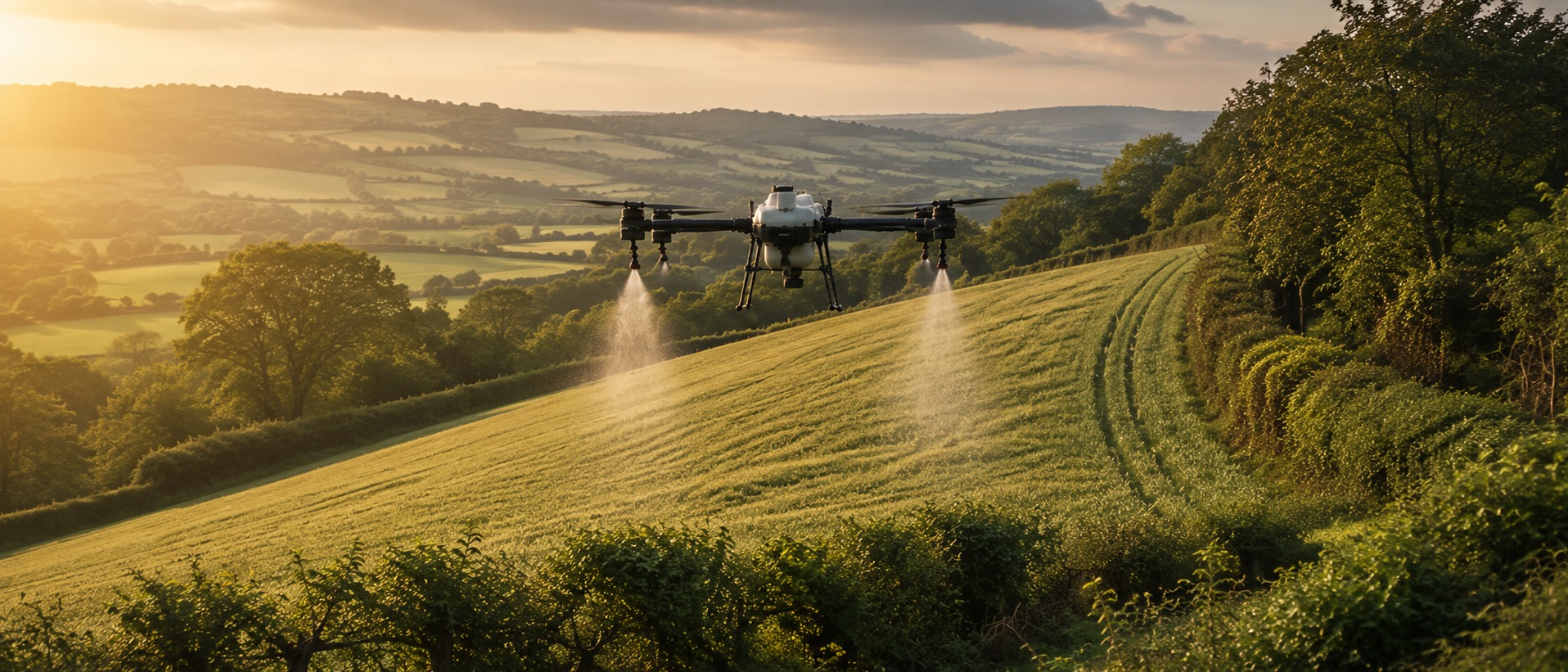
Where drone spraying genuinely helps
Drone spraying earns its place on jobs that a tractor and boom sprayer struggle with, rather than as a wholesale replacement for them. The clearest wins are difficult or wet ground, steep slopes, small or awkwardly shaped fields, protected crops, trial plots, and anywhere wheelings would damage the crop or compact the soil. On large, open, accessible fields a conventional sprayer is still faster and usually cheaper per hectare.
So the honest framing is not drone versus sprayer, but where a drone does something the sprayer cannot, or cannot do well.
The practical benefits
Used in the right place, the advantages are real:
- No soil compaction or wheelings, because nothing heavy drives across the field.
- Access to ground that machinery cannot safely or sensibly reach, such as steep, wet or broken land.
- Targeted, mapped application, so product can be placed only where it is needed rather than across a whole field.
- Less operator exposure to the crop and conditions, since the pilot stays at a safe distance.
- Quick mobilisation on small or urgent jobs where bringing in a sprayer is disproportionate.
Together these can mean less crop damage, more precise inputs and the ability to treat areas that would otherwise be left or done by hand.
The honest limits
Drones carry far less than a sprayer, so output per hour is lower and they are not suited to high-volume, broadacre work. Battery life, refilling and weather windows all pull down the real-world rate. For most large field jobs, ground equipment moves more product for less money.
There is also a cost and skills overhead. Heavy application drones, batteries, charging, training, insurance and servicing are a serious investment, which is why most farmers hire an operator rather than buy.
The regulatory reality
The biggest limit on drone spraying in the UK is not the technology, it is the law. Applying a pesticide by drone counts as aerial spraying, which is prohibited unless the Health and Safety Executive grants a permit, and there are currently no commercial authorisations, only a limited number of trials permits. So while the benefits are genuine, the range of liquid pesticide jobs you can legally have done by drone today is narrow. Spreading non-pesticide products and mapping are far more accessible.
Is it right for your job?
If your job is large, open and accessible, a sprayer or contractor is usually the better answer. If it is small, awkward, steep, wet, protected or sensitive, and the product and permissions fit, a drone can do something nothing else can. A good operator will tell you honestly which camp your job falls into.
To weigh it up, read what the rules currently allow, check the likely cost, and use the operator directory to find someone who can assess your specific site.
Related guides
- Agricultural drone law in the UK: what you can and can't do
- Drone spraying vs traditional spraying
- How much does drone spraying cost?
Useful links
Start with the operator directory, training providers, equipment page and quote request form.
FAQs
What are the main benefits of drone spraying?
Access to difficult or wet ground, no soil compaction or wheelings, targeted mapped application, less operator exposure, and quick mobilisation on small or urgent jobs. The trade-off is lower output than a conventional sprayer.
Is drone spraying better than a tractor sprayer?
Not in general. On large, open, accessible fields a boom sprayer is faster and cheaper per hectare. Drones win on small, awkward, steep, wet or protected sites where ground machinery struggles or would cause damage.
Does drone spraying reduce chemical use?
It can, because product is applied to a mapped area and only where needed, which suits spot treatment and variable-rate work. The actual saving depends on the job and how the application is planned.
Can I get any crop sprayed by drone in the UK?
No. Applying a pesticide by drone is aerial spraying, which needs a Health and Safety Executive permit, and there are no commercial authorisations yet, only trials permits. Non-pesticide spreading and mapping are much more accessible.