
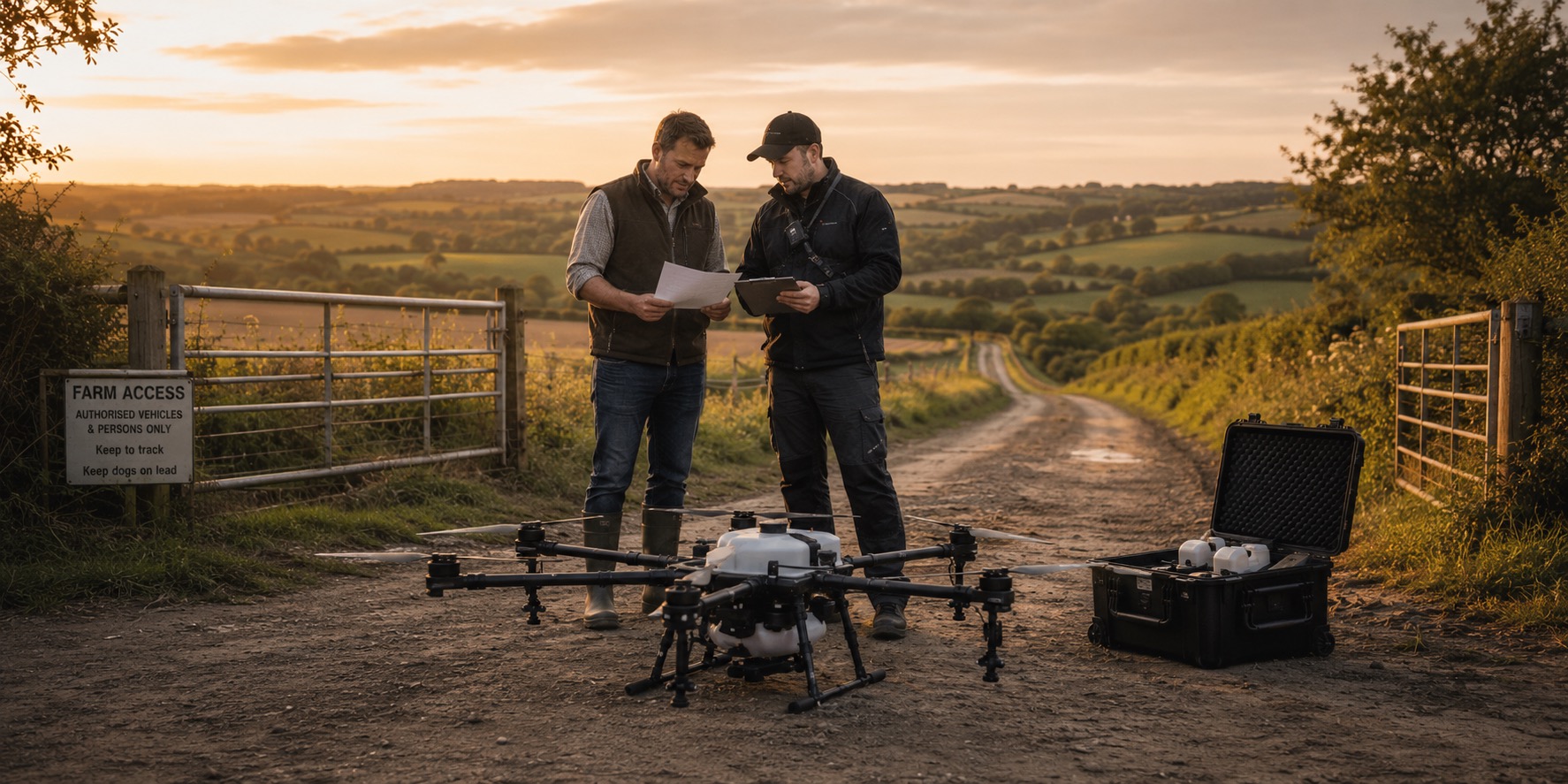
Two separate rulebooks: aviation and pesticides
Two different authorities regulate farm drones, and you often need to satisfy both at once. The Civil Aviation Authority governs the flying itself: the aircraft, the pilot and the operation. The Health and Safety Executive governs anything to do with applying pesticides. A job can be perfectly fine under one and blocked under the other, so it helps to picture them as two separate boxes that both have to be ticked.
As a rough rule, the more you are putting a chemical onto a crop, the more rules you pick up. Mapping a field touches only the aviation side. Spreading seed adds very little. Spraying a pesticide brings in the full pesticide regime on top of the flight permissions. This guide works through each activity in that order, from the most accessible to the most restricted.
Spraying pesticides by drone: tightly restricted
This is the activity most people ask about, and it is the most controlled. Under the Plant Protection Products (Sustainable Use) Regulations 2012, applying a pesticide by drone is treated as aerial spraying, and aerial spraying is prohibited unless the Health and Safety Executive has granted an Aerial Spraying Permit for that specific operation. In the HSE's own words, a permit is required every time you intend to apply a pesticide from the air, and that includes all applications by drone.
Just as important, there are currently no commercial authorisations, on-label or otherwise, that allow pesticides to be applied by drone in the UK. The spraying that does happen is taking place under a limited number of Extrapolated Trials Permits, which let a named operator treat a restricted area to gather data for a future commercial approval. In plain terms, there is no general right to spray a licensed pesticide on a field by drone today.
A legitimate pesticide drone operation right now involves all of the following:
- A product and use case covered by a trials permit, or in future a commercial authorisation
- An HSE Aerial Spraying Permit referencing each application
- Operators holding PA1 and PA6 certificates, or equivalent, as the HSE currently requires
- A CAA Operational Authorisation for the flight itself
- The drone's application equipment inspected under the National Sprayer Testing Scheme
- The public forewarned and access restricted around the treated area
A few practical details catch people out. Only the spray volumes authorised on the product label may be used, so the low and ultra-low volume techniques often associated with drones are not currently permitted here. The trials route is also neither quick nor cheap: an Extrapolated Trials Permit lasts three years, a typical application has run to several thousand pounds in fees, and the HSE aims to assess applications within about a year. If an operator suggests they can simply turn up and spray your crop with a licensed pesticide, treat that as a reason to ask a great deal more, not less.
Spreading seed, fertiliser and slug pellets
Spreading covers solid and granular products rather than liquids, and the rules depend entirely on what the product is. Spreading something that is not a plant protection product, such as cover crop seed or fertiliser, sits outside the aerial spraying rules. You still have to fly legally, but there is no pesticide permit to obtain for the product itself, which is why seeding and fertiliser spreading are among the more accessible farm drone jobs.
The picture changes the moment the granule is a pesticide. Slug pellets, for instance, are a plant protection product, so applying them by drone falls under the same aerial application rules as spraying. This is one of the more active areas of progress: a trials permit has been granted for a slug pellet product, intended to pave the way towards the first commercial approval for applying a pesticide to a UK food or feed crop by drone. Until that approval exists, slug pellet work by drone still runs through the permit and trials route rather than as routine spreading.
Mapping, scouting and survey flights
If no product leaves the aircraft, the pesticide rules do not apply at all. Mapping, crop scouting, multispectral surveys, drainage checks and similar work are governed purely by the aviation rules. For many farms this is the easiest place to begin, and it is where a lot of genuine value sits, because good field data improves decisions whoever ends up doing any application.
That does not mean there are no rules. You still need to be registered, fly within the law, and, depending on the aircraft and where you fly, hold the right operational permission. The next section covers what that involves.
Aviation permissions and pilot qualifications
The CAA sorts drone flying into three categories: Open for the lowest-risk flights, Specific for higher-risk operations flown under an authorisation, and Certified for the most complex. The decisive factor for agriculture is weight. A loaded application drone is heavy, often well over 25 kg, and the popular machines such as the DJI Agras T50 and XAG P100 Pro sit firmly in that bracket. That takes them out of the everyday Open category and out of the standard PDRA01 permission, which only covers aircraft up to 25 kg.
To fly a heavy application drone commercially you therefore need a bespoke Operational Authorisation in the Specific category. Since April 2025 these applications are built on the UK Specific Operations Risk Assessment, known as SORA. The baseline pilot qualification is the General VLOS Certificate, and any commercial operator must also register with the CAA for an Operator ID. The wider drone framework was modernised at the start of 2026, lowering the registration threshold and bringing in product class marks and Remote ID for new aircraft, but for agricultural machines the headline is unchanged: they are Specific category aircraft that need a proper authorisation behind them.
One arrangement worth understanding is the operator of record. Many UK operators, particularly in the XAG and AutoSpray world, fly under a network's Operational Authorisation rather than holding their own. That is a legitimate way to work, but it changes who is legally responsible for the flight, so it is always worth asking who the actual drone operator is and who you would be contracting with.
Insurance, records and protecting people nearby
Commercial drone work must be insured to the standard required for aircraft operations, and the cover should match the activity, including any application work, rather than being generic business insurance. Ask to see a certificate that clearly makes sense for the job in front of you.
For pesticide work the responsibilities go well beyond the flight. Records must be kept, application equipment must be inspected on the National Sprayer Testing Scheme schedule, the public must be forewarned and kept away from treated areas, and water and conservation areas must be protected. The HSE shares details of proposed aerial applications with the water industry, and consults nature conservation bodies where treatment is in or close to a protected site. None of this falls away simply because the sprayer happens to be flying.
Where the rules are heading
The direction of travel is towards allowing more drone application, carefully and on the back of evidence. The first UK trial permit for an aerial biocide application has been granted, the slug pellet trial is moving towards a commercial approval, and the HSE has said it is reviewing operator certification in anticipation that commercial authorisations will follow. This is a genuinely fast-moving area, and the detail can shift from one season to the next.
For that reason, treat this guide as an accurate snapshot rather than the final word, and confirm the current position with the CAA, the HSE and the operator before committing to any job. This guide was last reviewed in June 2026.
What this means for you
If you are a farmer hiring a drone operator, match your expectations to what is currently lawful. Mapping and non-pesticide spreading are realistic today. For anything involving a pesticide, ask the operator exactly which permit or authorisation covers your job, and be wary of anyone who brushes the question aside.
If you are thinking of becoming an operator, build from the accessible end. Mapping and seed or fertiliser spreading let you gain experience and earn while the pesticide framework matures, and they still require you to get the aviation side right. When commercial spraying authorisations do arrive, the operators already flying safely and keeping good records will be best placed to use them.
From here it is worth browsing the operator directory by region and service, reading the hiring checklist before you send an enquiry, and using the cost guide to set a realistic budget.
Related guides
- Is drone spraying legal in the UK?
- How much does drone spraying cost?
- What to ask before hiring a drone operator
Useful links
Start with the operator directory, training providers, equipment page and quote request form.
FAQs
Is it legal to spray pesticides by drone in the UK?
Only under strict control. Applying a pesticide by drone counts as aerial spraying, which is prohibited unless the Health and Safety Executive grants an Aerial Spraying Permit for the specific operation. There are currently no commercial authorisations for pesticide application by drone in the UK, so the work that does happen is taking place under a limited number of trials permits.
Do I need a permit to spread fertiliser or seed by drone?
Spreading products that are not plant protection products, such as seed or fertiliser, sits outside the aerial spraying rules, so there is no HSE pesticide permit to obtain for the product. You still have to follow CAA flight rules. Spreading a pesticide such as slug pellets is different, because it is still a plant protection product and currently needs the same permit route as spraying.
Can I map or scout my own fields with a drone?
Yes. Mapping and scouting apply no product, so the pesticide rules do not come into it. You still need to follow CAA rules: register for an Operator ID, and for heavier aircraft or operations beyond the Open category you need a Specific category Operational Authorisation.
What qualifications does a drone spraying operator need?
Two sets. On the aviation side, a General VLOS Certificate and a CAA Operational Authorisation. On the pesticide side, the HSE currently accepts PA1 and PA6, or equivalent certificates, as a proportionate interim requirement, and has signalled this will move to a drone-specific qualification in future.
Why are agricultural drones treated more strictly than camera drones?
Mainly weight and what they carry. Loaded application drones weigh well over 25 kg, which puts them in the CAA's Specific category rather than the everyday Open category. On top of that, applying any pesticide from the air brings in the HSE aerial spraying rules.
Is drone spraying about to become fully legal in the UK?
It is moving in that direction but is not there yet. Trials permits, including a first UK permit for an aerial biocide application and a slug pellet trial, are generating the data needed to support future commercial authorisations. Until those are granted, treat any claim of routine, fully approved drone spraying with caution.